
¿Los sombreros provocan caída del cabello?



If you’re a guy dealing with a receding hairline or thinning hair at the top of your head, you’re far from alone.
Male pattern hair loss is the most common form of hair loss amongst those assigned male at birth (AMAB). Also called male androgenic alopecia (AGA), it’s so common that up to 50% of males lose some hair by age 50.
Despite it being so common, we humans have made a lush head of hair an unreasonable beauty standard. So while AGA doesn’t cause physical pain, the psychological effects can be significant. AGA can challenge self-identity and self-esteem. It can also trigger mental health conditions, including anxiety, depression and body dysmorphic disorder.
The good news is that three proven hair loss medicines can slow and reverse hair loss. But which one is best for you?
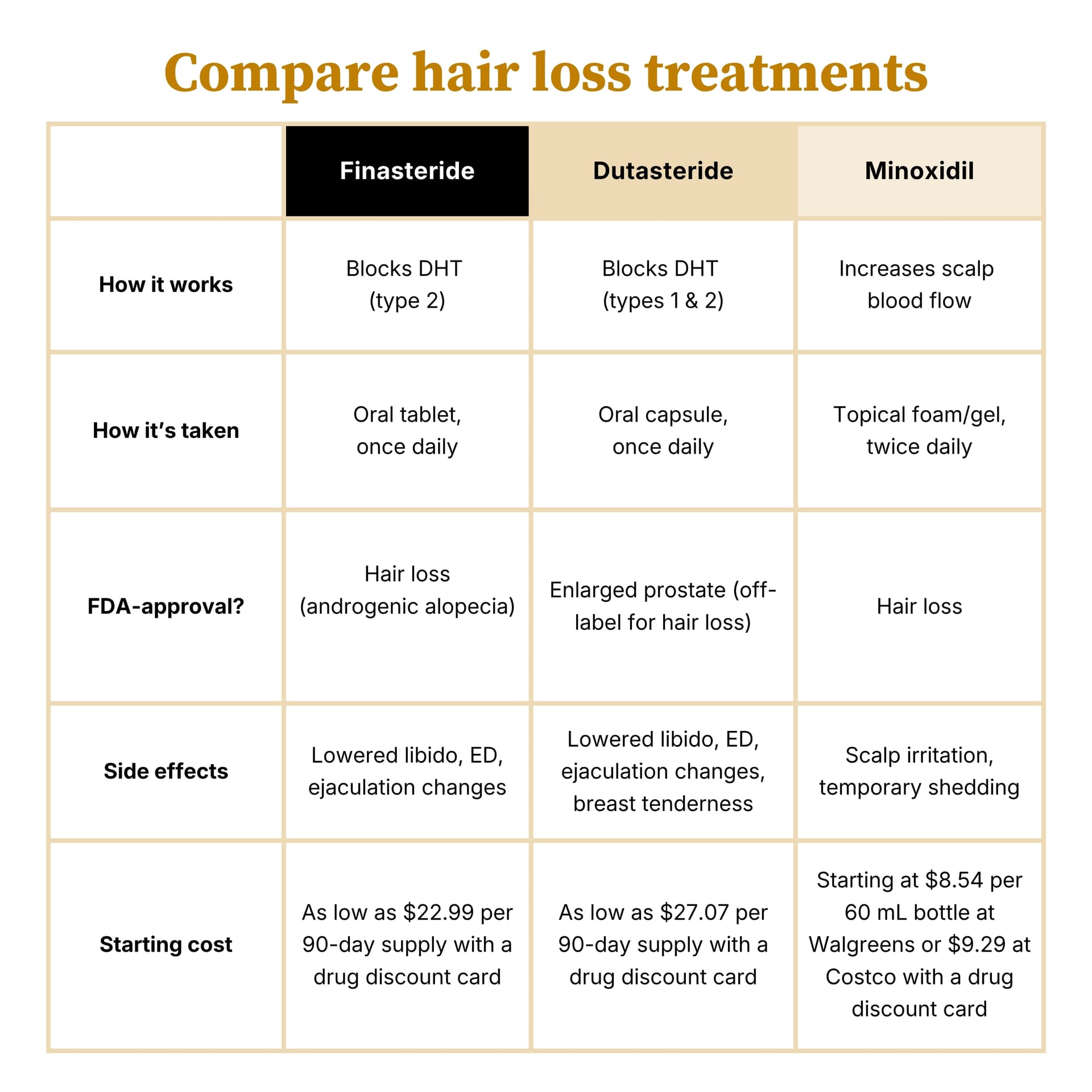
In this article, we break down how Finasteride, Dutasteride and Minoxidil compare—and how you can get prescription hair loss treatment online with a discreet $19 consultation.
The main type of hair loss for males is androgenic alopecia—also called AGA or male pattern hair loss.
Each strand of hair grows for two to six years before resting for a few months and then falling out. When a hair follicle starts to grow a new strand, the cycle begins again.
Dihydrotestosterone (DHT) is an androgen that helps control this hair growth cycle. Too much DHT stimulation can shrink hair follicles, shorten growth periods, and thin strands. So, AGA is thought to be caused by an overproduction of DHT.
For males, AGA usually appears as a receding hairline and thinning of hair around the crown of the head. Eventually, hair may only thin out or stop growing altogether.
Contributing factors to male pattern hair loss include:
Finasteride is an FDA-approved hair loss treatment for people with male-pattern hair loss. It works by blocking type 2 of an enzyme called 5-alpha-reductase. This enzyme converts testosterone into dihydrotestosterone (DHT). By blocking DHT, it prevents hair strands from thinning and can help restart hair growth.
Finasteride is the generic form of Procecia and is usually taken as a tablet once a day.
Finasteride affects testosterone levels and can cause congenital disabilities. So, it is only available to those who have no chance of getting pregnant—those assigned male at birth (AMAB).
Mild Finasteride side effects include:
Dutasteride is another hair loss medication for people with male-pattern hair loss. It also works by discouraging the buildup of the DHT hormone. But while Finasteride targets only type 2 of the 5-alpha-reductase enzyme, Dutasteride blocks both types 1 and 2. This makes Dutasteride a more potent drug for slowing hair loss and regrowing hair.
Dutasteride is the generic form of Avodart. Most people take it as a capsule once daily. Like Finasteride, it’s only available to those assigned male at birth.
Dutasteride is FDA-approved for the treatment of an enlarged prostate and is prescribed off-label to treat hair loss. Prescribing medications for off-label use when medically appropriate is a common and legal practice. So, if a provider prescribes it, you should have no qualms about taking Dutasteride for hair loss treatment.
Dutasteride side effects include:
Minoxidil is the generic version of Rogaine. It works differently from Finasteride and Dutasteride. Rather than targeting DHT, topical Minoxidil increases blood flow to the scalp and extends the growth phase of hair follicles. This helps to stimulate regrowth in areas affected by hereditary hair loss, including male pattern baldness.
At Dr. B, Minoxidil is available as a topical foam or gel applied to the affected area twice daily.
Common Minoxidil side effects include:
All three treatments are proven options for male pattern hair loss, but they work in different ways and suit different situations.
Finasteride is the only 5-alpha-reductase enzyme inhibitor specifically FDA-approved for hair regrowth. So it’s most providers’ go-to hair loss treatment. Dutasteride may offer stronger results for some patients. Minoxidil is a good option for those who prefer a topical treatment or want to combine approaches.
Some patients use more than one treatment. Talk with your provider about what makes sense for your health history and hair loss pattern.
Patients are sometimes concerned about the link between DHT inhibitors and prostate cancer risk. Studies suggest that Dutasteride can lower prostate-specific antigen (PSA) levels. This won’t increase prostate cancer risk. But because PSA levels are markers in prostate cancer screening, some providers won’t prescribe it to those with a family history of prostate cancer. Finasteride lowers overall prostate cancer risk. But some studies suggest that it increases the risk of high-grade prostate cancer.
So share your complete health history with your provider and discuss these risks before taking Dutasteride or Finasteride.
Getting started is affordable—and often cheaper than a single doctor's office visit. Here at Dr. B, we offer $19 online hair loss consultations. There’s no membership required, and a licensed health care provider will usually review your request within 3 hours.
Costs can vary based on your insurance and where you shop for medications, but typical costs might be:
With insurance, most patients pay a $10–40 copay for their medication. Dr. B provides a drug discount card with each prescription to help lock in the lowest available price.
Yes! You can get a Dutasteride prescription, Finasteride prescription, or Minoxidil prescription online through a $19 hair loss consultation.
You’ll share a bit about your health history and current symptoms through our chat-like platform. A licensed provider will review your information within three working hours and, if appropriate, send a prescription directly to your chosen local or online pharmacy. We’ll even send you a Dr. B Drug Discount Card to help you lock in the lowest hair loss treatment price possible!
Dr. B also offers the brand hair loss medications Avodart and Propecia online. These medications contain the same active ingredients as Dutasteride and Finasteride. But because they’re brand-name medications, they usually come at a higher price tag.
If you’re ready to reverse your thinning hair or get on the road to regrowth, start your consultation today.